

A rapidly growing population and expanding infrastructure keep the surface of the Earth in constant motion. Roads settle, dams shift, coastlines erode, crops stress, fires spread. Earth observation (EO) is how we watch that change from a distance, at a scale no ground survey can match.
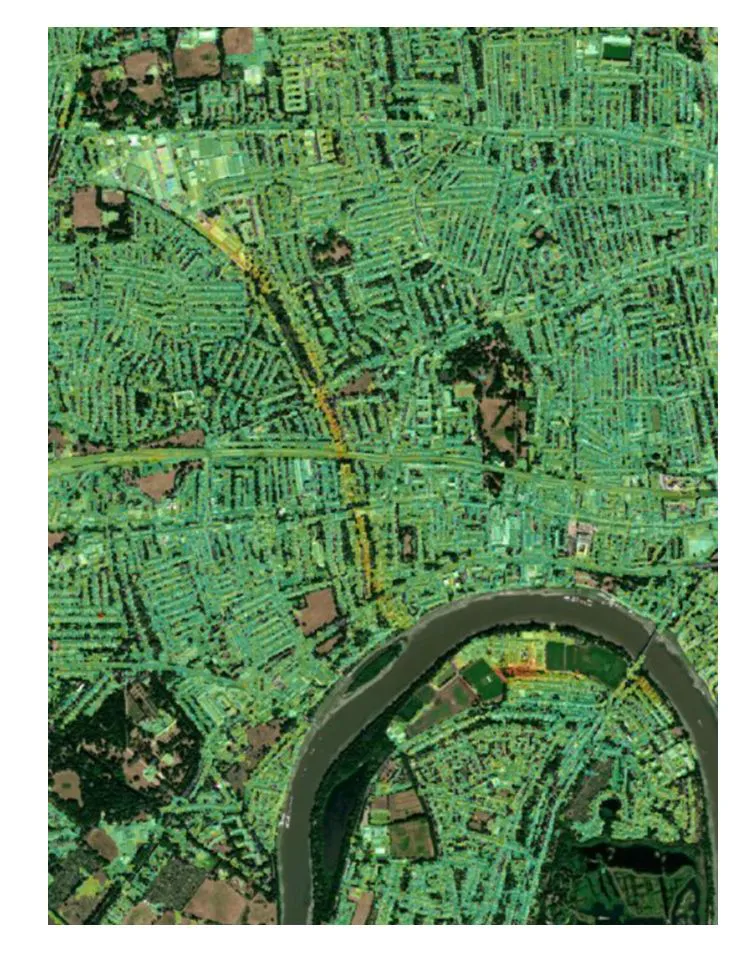
Earth observation in a single frame: satellite radar (InSAR) resolves a whole city’s ground movement from orbit, the founding example of the change EO exists to watch. InSAR imagery courtesy 3vGeomatics.
Canada has made the case in policy. The New Space Strategy for Canada (2019) and the Strategy for Satellite Earth Observation (2022) both set out to use space-based data to support science, innovation and economic growth. [1, 2]
A strategic national asset
The numbers are substantial. Canada’s space sector contributes roughly $2.3 billion to national GDP, directly employs almost 10,000 people, and ranks among the most research-intensive parts of the economy. Small and medium businesses make up more than 90 percent of Canadian space firms. [1]
Beyond economics, the strategy frames space as a strategic national asset: it underpins national security and connects Canadians in rural and remote communities. Its priorities read like a map of where EO delivers value:
- Health at a distance. AI and autonomous medical systems that monitor vital signs, prevent illness, run diagnostics and deliver care across great distances, especially for remote communities.
- Food security. Growing nutritious food effectively in remote regions with harsh environments.
- Climate. Collecting the long-baseline data that makes climate change measurable.
- Data analytics. Open data policies and the infrastructure to process, analyse and distribute data, so researchers and firms can turn vast space-generated datasets into new applications. [2]
The mandate ROSS was built for
That last priority is the through-line. EO is only useful once the raw signal becomes a decision, and that is the work ROSS does: turning remote signals into decisions across any sensor and any platform, from satellite radar to airborne and robotic sensing. The rest of this series follows that path, starting from a single satellite pass and ending on the ground.
Sources
- Innovation, Science and Economic Development Canada, A New Space Strategy for Canada (2019). asc-csa.gc.ca
- Innovation, Science and Industry, Canada’s Strategy for Satellite Earth Observation: Resourceful, Resilient, Ready (2022). asc-csa.gc.ca