

On Thursday, October 15, 2026, the ROSS Club held a hybrid session, in person in the MM Lab (UCOMM 4-140) and online on Zoom. Host Dr. Alvin (Xinyao) Sun opened with a short welcome, then Dr. Jiating Li (Assistant Professor, Biosystems Engineering, University of Manitoba, and lead of the Agricultural Intelligence and Digital Engineering (AIDE) Lab) gave the featured talk, From sensing to decisions through multi-scale observations and modeling for sustainable crop production, followed by Q&A. The recording, the key points and the discussion threads are below. The original announcement is here.
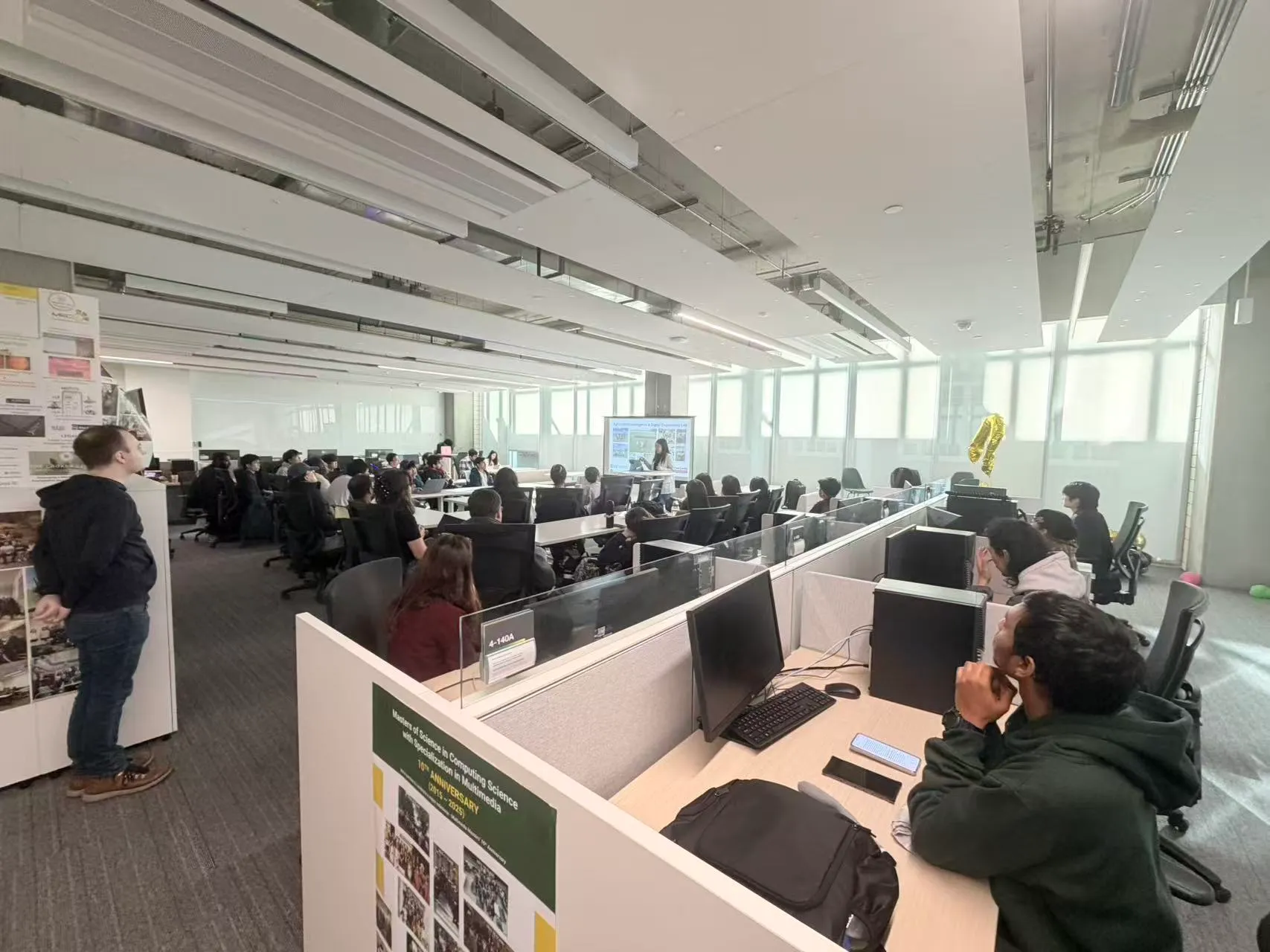
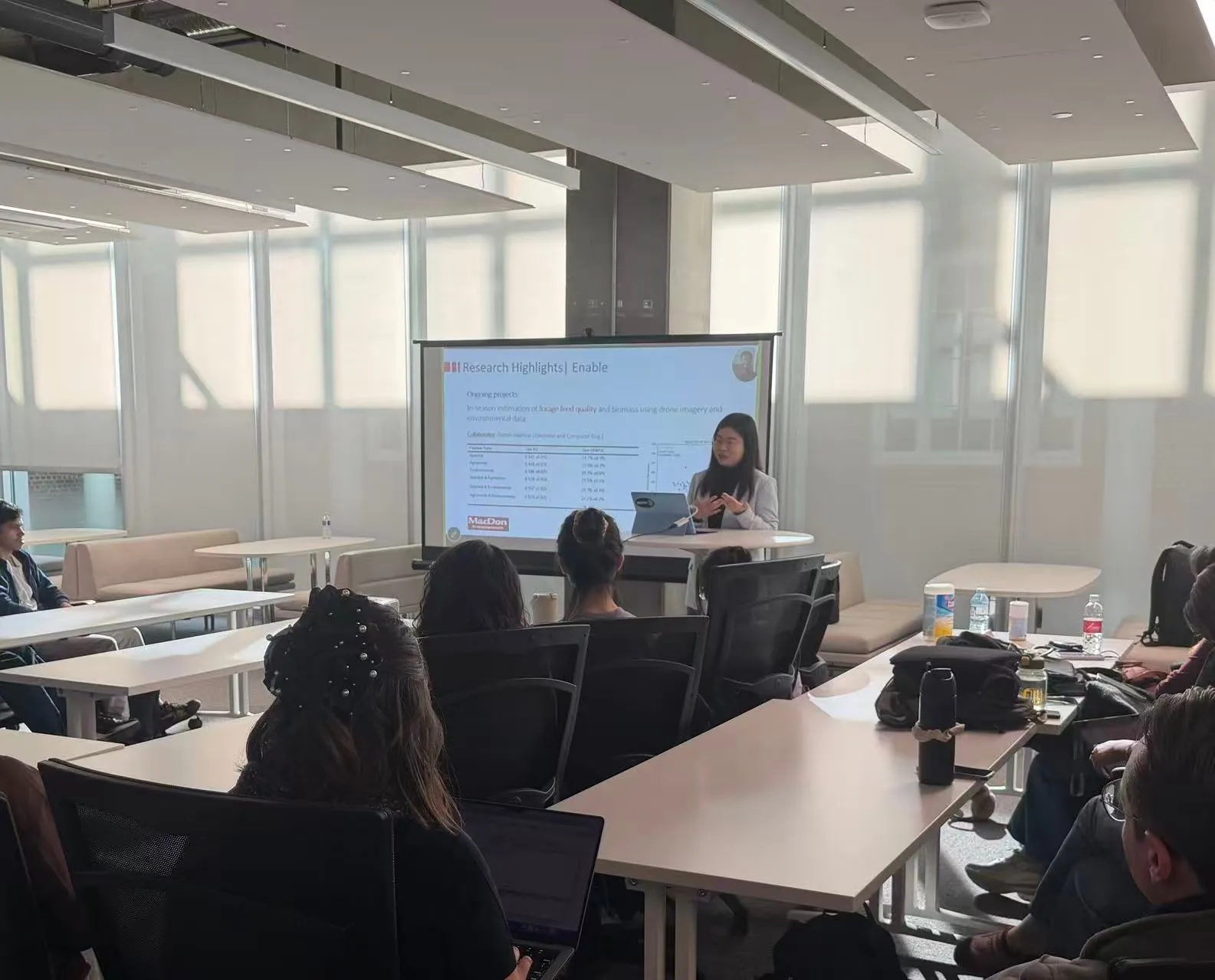
Dr. Jiating Li presents to a full MM Lab, UCOMM 4-140. Photos by the ROSS group.
Watch the recording
Watch on Zoom (about 56 minutes).
From Sensing to Decisions
The challenge. Crops in the field respond at once to light, wind, rainfall, soil, insects and disease, and these factors interact. A single sensor cannot capture that interaction, and a model trained under one stress condition tends to fail under another. Dr. Li’s goal is engineering tools that stay robust across conditions and turn observations into actionable knowledge: which variety a breeder should select, and, for a farmer, which variety to plant, at what depth and row spacing, and how much fertiliser and water to apply in season. Today many of those decisions still rest on experience. Her research follows three connected directions: observe, predict and enable.
Observe: drone remote sensing.
- Her graduate work used drones carrying four kinds of sensor. RGB is the baseline. Multispectral adds the red-edge and near-infrared bands most closely tied to crop stress. Hyperspectral narrows the bands to capture far more spectral detail. Thermal reads leaf temperature: a healthy plant transpires through small openings in its leaves, which cools the surface, so stressed plants show up warmer.
- Plant height comes from the difference between a digital surface model and a digital terrain model, both built from a structure-from-motion point cloud.
- Canopy temperature comes from a dual-gimbal RGB and thermal payload. Thermal sensors are still low resolution, so the thermal image is co-registered with the RGB segmentation to remove soil pixels.
- Vegetation indices such as NDVI and NDRE sharpen the contrast between healthy and stressed plants.
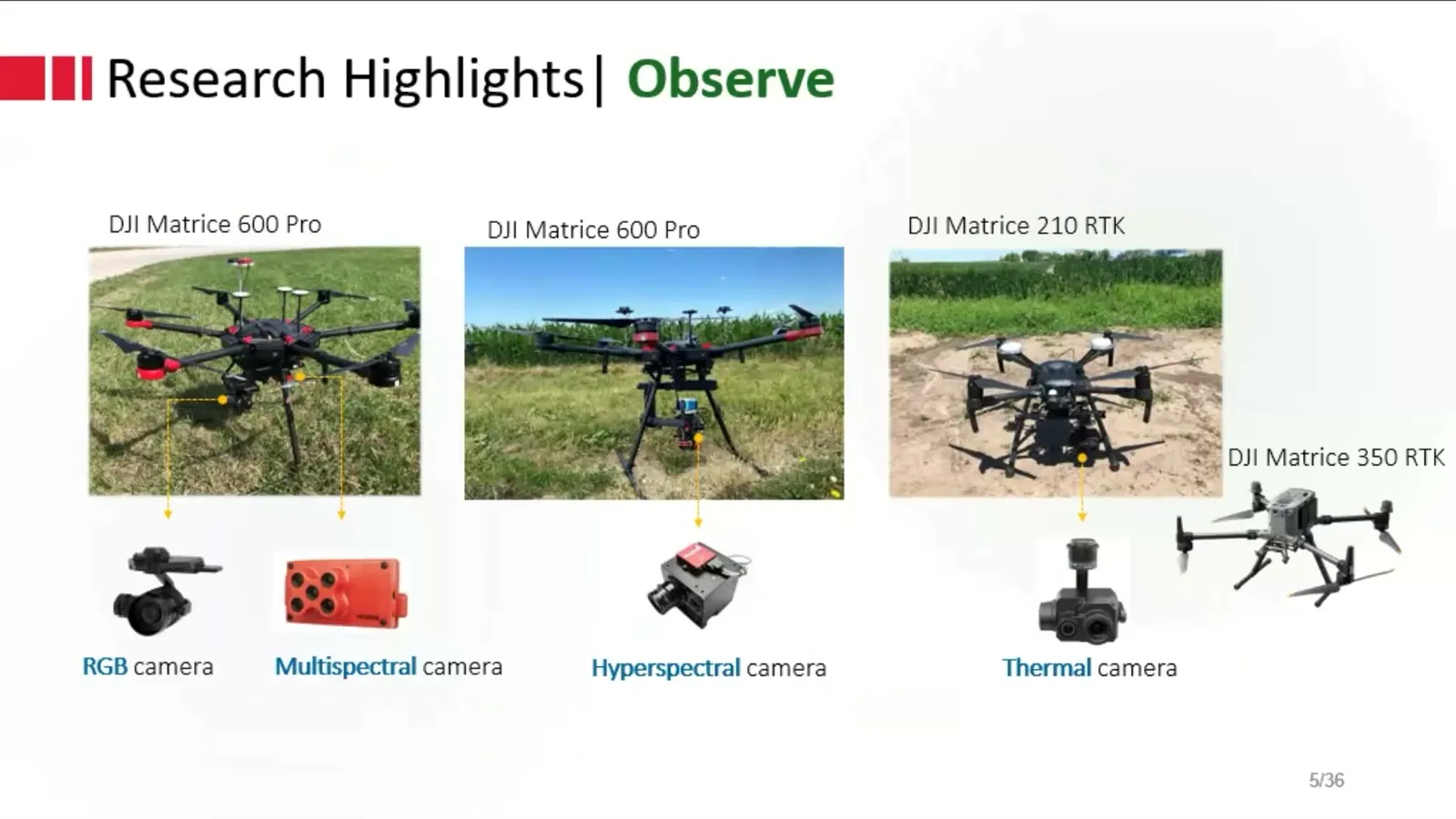
Drone platforms and the camera each one carries. Slide by Dr. Jiating Li, AIDE Lab.
Observe: closer than a drone can fly.
- Most research drones cannot fly close to the crop because of propeller downwash. During her postdoc, Dr. Li worked on a cable-suspended phenotyping system, the same idea as the camera that moves above a football field. It carries a heavier payload and can, in principle, come right down to the canopy.
- Her focus there was LiDAR. The workflow isolates single plots and extracts canopy height, volume (linked to biomass) and leaf area index, and repeated scans give a growth curve for each plot. LiDAR worked well for upright crops such as corn and sorghum. For soybean, once the canopy closed, the laser only reached the top layer, the same limit a drone faces.
- Her lab then built a 30-centimetre-wide ground robot that travels between crop rows and images plants from several angles. It sees the stems, where some diseases and lodging (plants falling over in storms) start, and it reduces occlusion from tilted leaves. In a field trial with markers placed on stems, the robot’s images caught stem markers 47 times (counting repeat views), against once for a drone flown manually about three metres above the canopy and never for one flying automatically at its ten-metre minimum.
- The original motivation was wheat disease. Leaf rust and stem rust look alike from above, but stem rust appears only on the stem, so only a view of the stem can tell them apart.
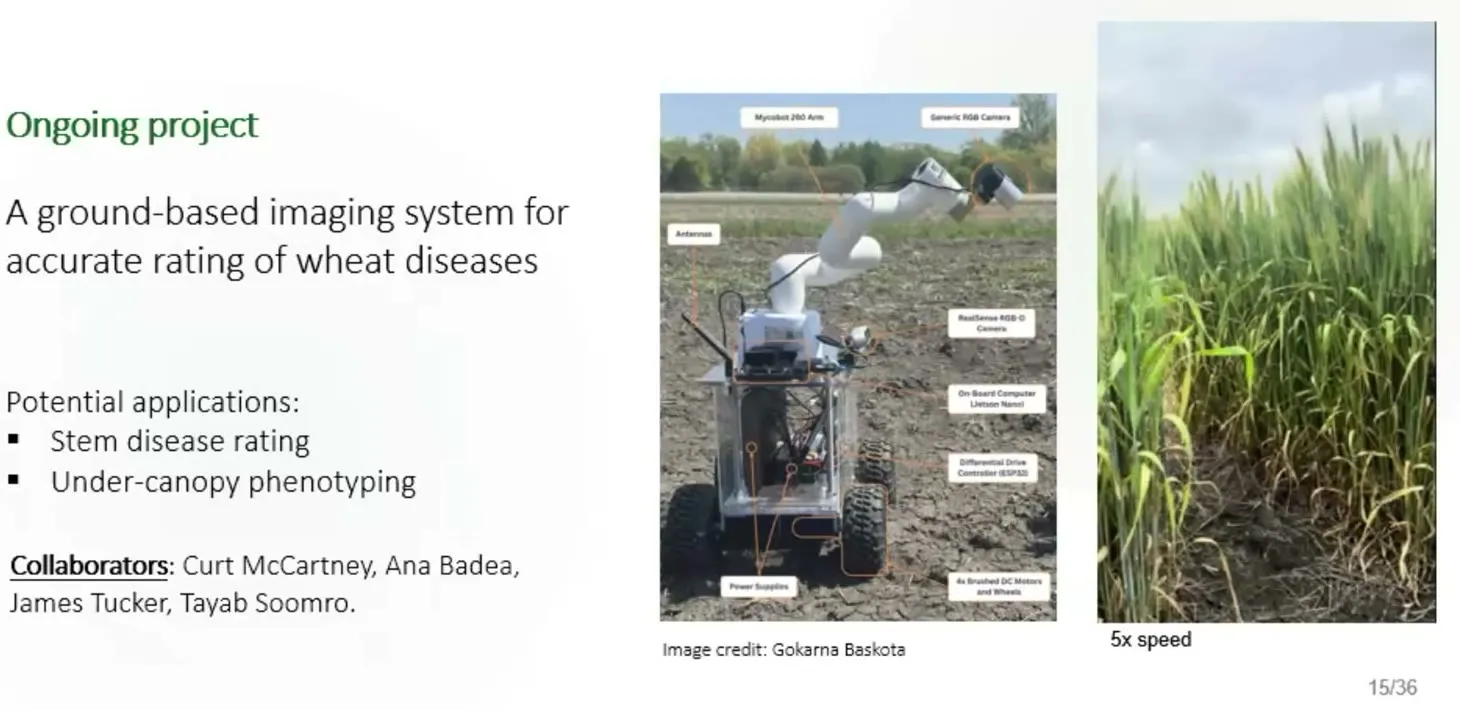
The ground robot for wheat disease rating, with its view from inside the crop. Slide by Dr. Jiating Li, AIDE Lab, robot photo by Gokarna Baskota.
Predict: crop nitrogen with knowledge-guided AI.
- Precise nitrogen management starts with knowing how much nitrogen the crop already holds. Dr. Li used drone hyperspectral imaging, which records a full spectrum (roughly 400 to 1,000 nanometres) for every pixel, with reflectance calibration against a field tarp, ortho-rectification and stitching of the image cubes.
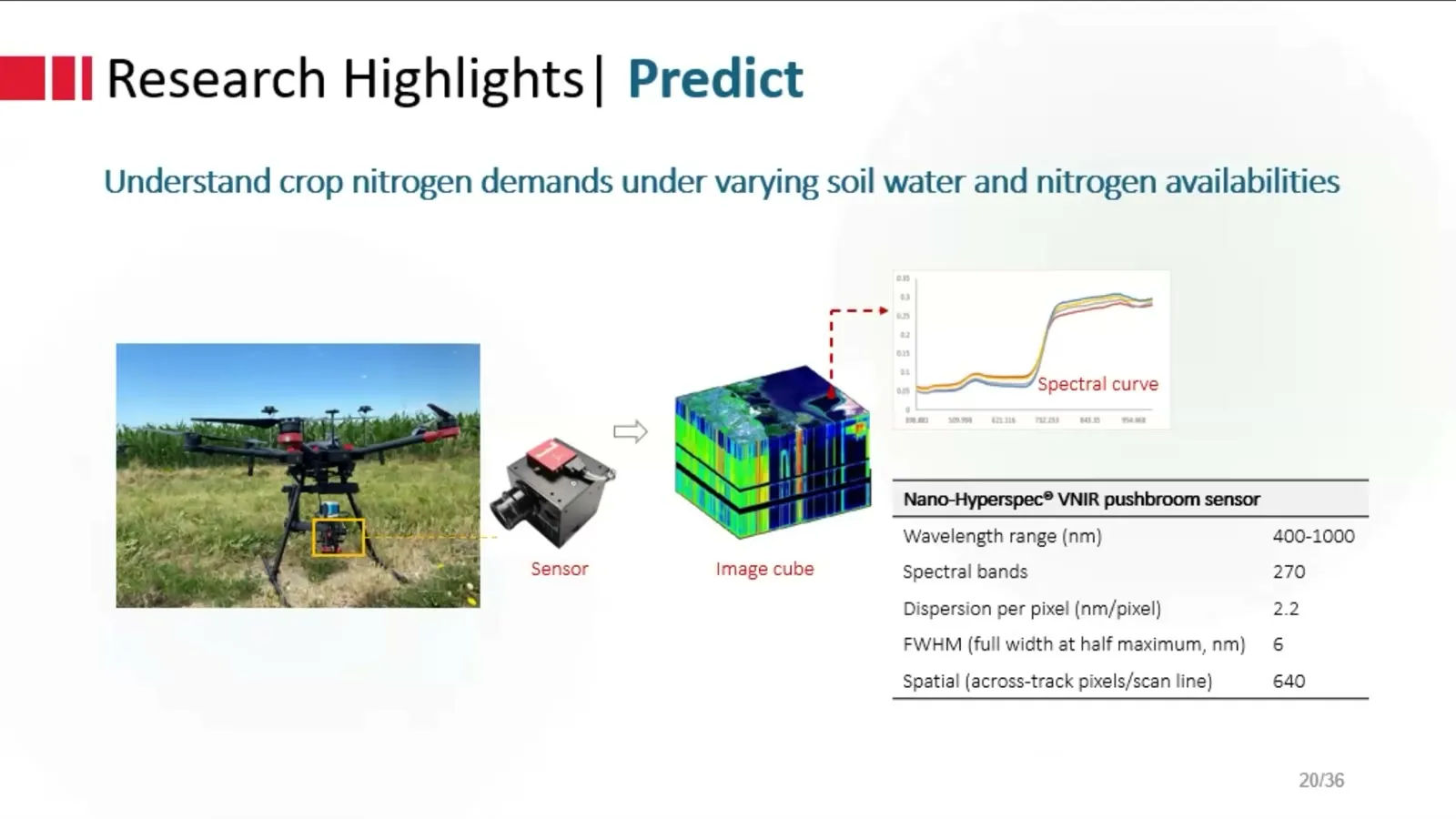
The hyperspectral drone, its image cube and a per-pixel spectral curve. Slide by Dr. Jiating Li, AIDE Lab.
- The trials spanned several sites with different irrigation and nitrogen treatments. Soil water and nitrogen interact, and their joint effect is not the sum of the two.
- Pure AI needs large datasets, which agriculture rarely has. At one site she could collect only 14 ground-truth samples, which took three hours of walking through three-metre-tall corn in summer heat.
- Her answer was a hybrid approach. A radiative transfer model, which simulates how light interacts with the canopy, carries domain knowledge that guides the AI and makes it less dependent on sample size. Compared with common machine learning methods and standard vegetation indices, it performed best across four study sites, with a narrower spread that points to better generalisation. Across growth stages it had the lowest average error and the smallest variation in error.
Enable: from predictions to decisions.
- Resistant soybean varieties. Iron deficiency chlorosis causes yellowing, necrosis, stunting and eventually plant death, and breeders rate it by eye. Dr. Li’s group trained a model on drone RGB imagery to rate severity. The trial plots sat inside farmers’ fields, so the group also flew the surrounding unlabelled soybean and used it for self-supervised pretraining with a convolutional autoencoder before fine-tuning a CNN. Pretraining on that “useless” imagery improved rating accuracy.
- Biological nitrogen fixation. An ongoing project studies how soil water and nitrogen jointly affect nitrogen fixation in soybean and dry bean.
- Nitrogen guidance for corn. Corn acreage is growing in Canada as temperatures rise, and the existing guidance is 10 to 15 years old, predating today’s varieties and conditions.
- Forage cut timing. In-season estimates of forage quality and biomass help farmers pick when to cut. Environmental data predicted feed quality better than drone imagery did, but the imagery stays in the model because it adds the spatial view: which part of a field to harvest first.
Discussion highlights
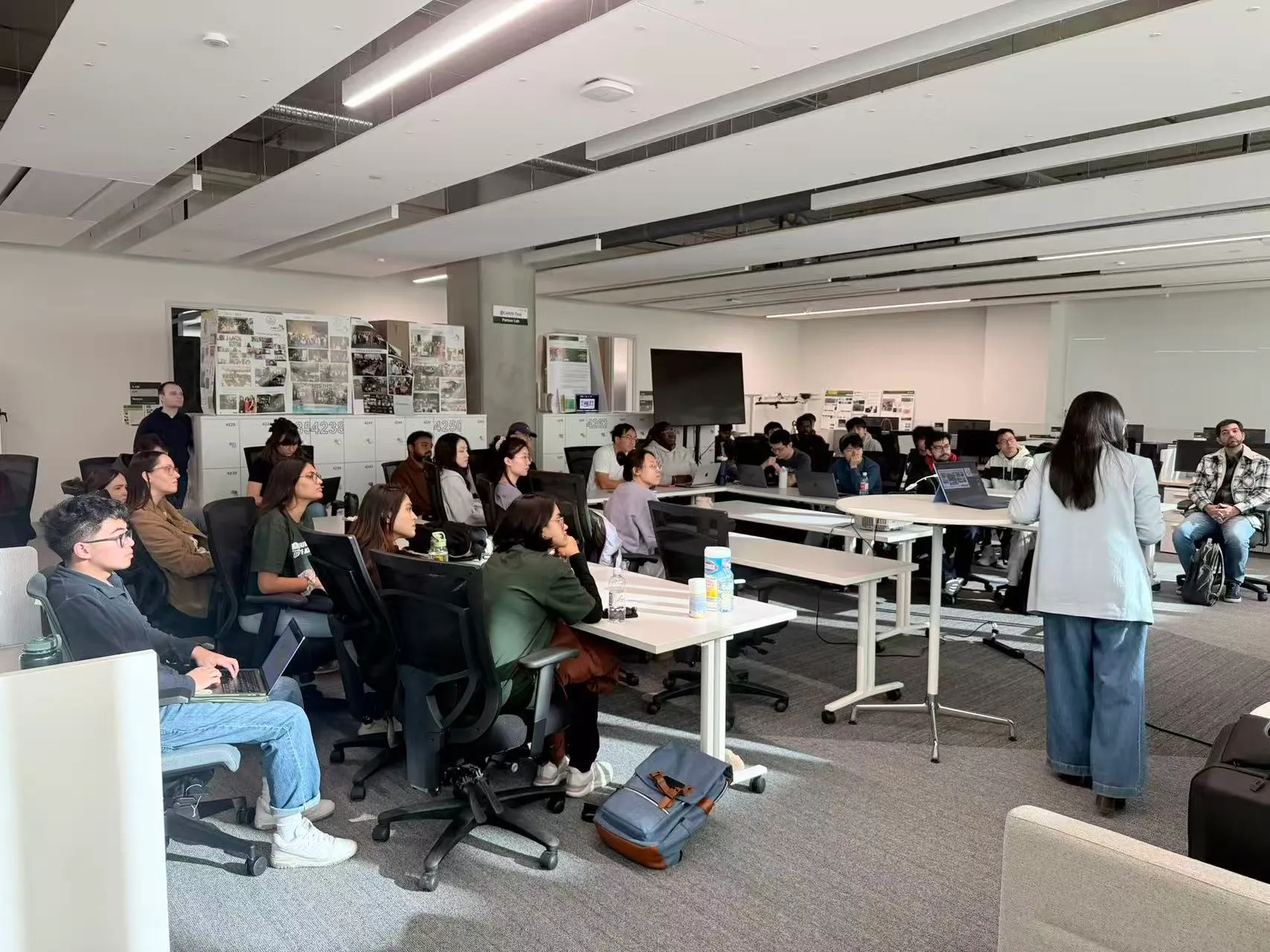
Dr. Jiating Li with the audience in the MM Lab. Photo by the ROSS group.
- Is the hyperspectral data reduced, for example with PCA? No. After calibration and stitching, the radiative transfer model takes the full spectrum at one-nanometre steps, so no downsampling was needed, though PCA is a valid option for data reduction.
- How does the physics knowledge enter the model? Knowledge-guided machine learning can use physics as a loss term, as a simulator, or inside the architecture. Dr. Li’s work so far uses the radiative transfer model as a simulator, and the other two are of interest next. A follow-up on uncertainty struck a chord: estimating it, alongside accuracy, is the planned next focus of her forage project, because farmers need to know how far to trust a prediction.
- Why soybean, corn and wheat? “I don’t pick the crop. I pick the person.” Her projects follow her collaborators in agronomy, plant science and soil science. In Nebraska that meant corn and soybean, while Manitoba’s mix is broader: canola, wheat, corn, soybean, dry beans, flax and alfalfa.
- Can yield models link to economic outcomes? Not yet. A recent proposal of hers includes fertiliser economics and the cost of adopting technology such as drones, which needs collaborators in agricultural economics. An attendee working in resource economics offered to follow up.
- What does an internship in the AIDE Lab involve? Interns join a planned project tied to an existing programme, usually with hands-on field data collection, sensor operation and data processing, ideally carried through to analysis and conclusions. Expectations differ for undergraduate and graduate interns.
Dr. Li’s lab welcomes short-term visitors and interns. Contact details are on her faculty page. To follow the next events, join the ROSS Club newsletter or visit the Club page. Speakers, datasets and partnership proposals are welcome.
Further reading: AIDE Lab